
For therapy
Therapy is fifty minutes.
The week is ten thousand.
Mind Matter isn't therapy and doesn't pretend to be. It's built to make the therapy you're already paying for work considerably harder for you.
The problem
"So, how was your week?"
It's the first question in almost every session, and it's genuinely hard to answer. Not because you're being evasive — because human memory doesn't work that way.
What you report tends to be coloured by how you feel sitting in that chair, right now. Arrive on a good day and the bad Tuesday evaporates. Arrive on a bad one and the whole fortnight sounds like a catastrophe. Either way your clinician is making decisions — about your treatment, sometimes about your medication — from a summary that got distorted on the way in.
Meanwhile the actual signal was there all along. It was in the four nights you slept badly before the argument. In the mood dip that started nine days after a dose change. In the fact that every genuinely good week involved being outdoors. Nobody can hold that in their head. A phone can hold it effortlessly.
What you bring
Walk in with a record, not a guess.
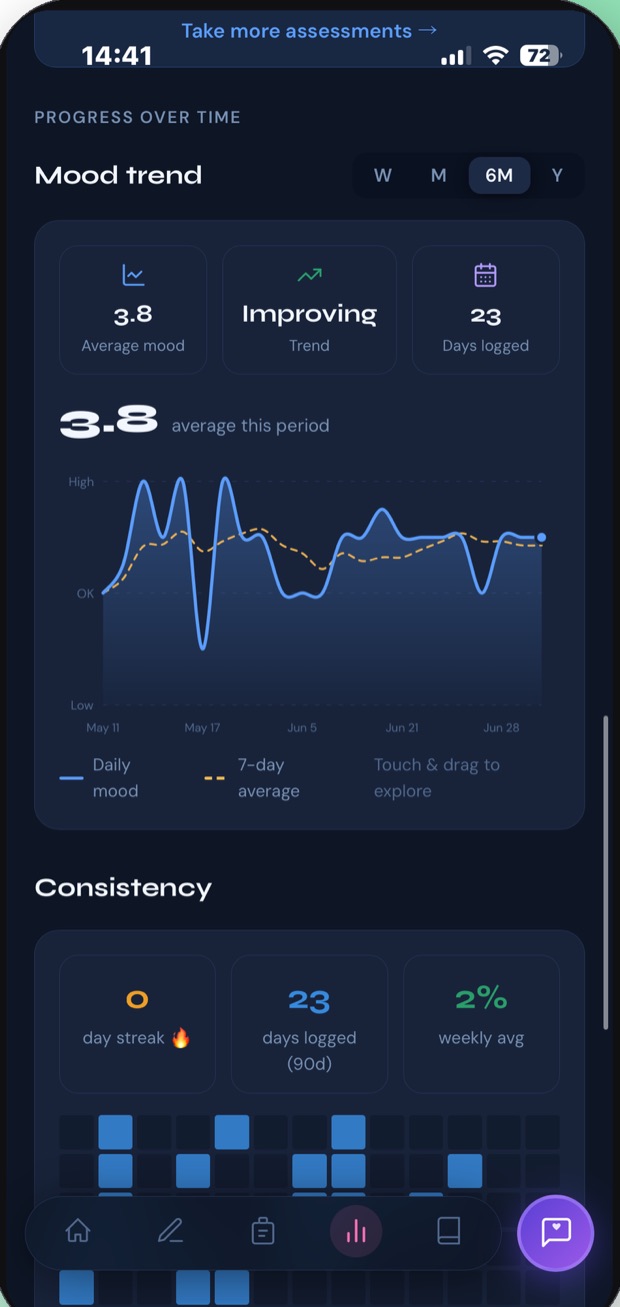
Mind Matter generates a clean summary of your tracked history — formatted to be read quickly by someone who has six other clients that day.
- Your mood trend since the last session, not since this morning
- Screener scores over time — a direction of travel, not one number
- Sleep, movement and medication logs alongside the mood line
- The specific days that were hardest, with what you wrote at the time
Between sessions
Where therapy actually happens.
Every good therapist will tell you the same thing: the hour is where you learn the skill, and the week is where you get better at it. That's the part most people quietly skip.
Skills within reach
DBT distress tolerance and emotion regulation skills available at the moment you need them — not in a worksheet in a drawer.
Thought records
CBT thought work you can do when the thought actually shows up, rather than reconstructing it a week later.
Medication tracking
What you took and when, next to how you felt — the single most useful thing you can hand a prescriber after a dose change.
Treatment plan
What you're trying, what your clinician suggested, and honest tracking of what's actually helping.
Somewhere to put it at 2am
The crisis that hits on a Saturday doesn't wait until Thursday. Bandura is there in between, for reflection, not advice.
A safety plan that exists
Written while you're steady, with your warning signs and your people, so it's ready before it's needed.
If you're the clinician
What this is, from your side of the room.
It's a client-owned record, not a clinical system
Mind Matter is a consumer wellness app. It isn't an EHR, it isn't HIPAA-covered infrastructure, and it doesn't integrate with your practice software. Your client owns the data and chooses what to show you.
The instruments are the real ones
PHQ-9, GAD-7, PCL-5, AUDIT, ASRS and thirteen others — published, validated, scored per the source papers, and cited to them. Screening indicators only; nothing in the app claims to diagnose.
The AI is labelled as an AI, loudly
Bandura is presented to your client as an AI character throughout — not a professional, not supervised by one, and explicitly not a substitute for you. The app is designed to route people toward care, not away from it.
Between-session adherence, made visible
If you assign homework, skills practice or mood logging, this is where it lands — and the record comes back to the session in a form you can read in thirty seconds.
If you're deciding between this app and seeing an actual human — see the human. This was built to make that go better, not to stand in for it.
In a crisis, reach a person
Mind Matter cannot monitor you and cannot respond to emergencies.
- 988 — Suicide & Crisis Lifeline (call or text, US)
- Text HOME to 741741 — Crisis Text Line
- 911 — or your local emergency number, if there's immediate danger to life
- Outside the US — findahelpline.com
Bring something real to your next session.
Start logging now and you'll have weeks of history by the time you next sit down.